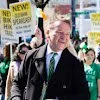
My campaign can find no record of being contacted by the Baltimore Sun or the Capital Gazette to submit responses to their Voter Guide. Once we saw the voter guide had been published, we reached out to editors and journalists, prepared responses and submitted them. The responses I submitted are below, and are now live on the Voter Guide.
What is one decision by current leadership that you believe is actively harming residents — and what would you do differently within your first 100 days?
I believe, based on my eight years in local government, working with county, state and federal partners, that – overall – our leadership generally tries to find the right balance between current and future resident needs. But I also know that residents suffer when decisions get made without enough transparency or community input. As I’ve travelled around District 6 over the past months, I’ve come to learn that many residents feel left out of the process entirely. The sewer challenges facing residents in Gingerville, and the recent upzoning in Millersville that has impacts for the Jabez Branch watershed, are two examples.
I also know that it isn’t always possible to deliver an outcome that everyone will agree on but communication and engagement early and throughout planning and decision processes are critical to building understanding and decisions that reflect majority views and priorities. That is what we did in planning the City Dock Resilience Project, in over 300 community and stakeholder meetings, and adapting our plans many, many times as a result.
That is the approach I will continue to take. In my first 100 days I’ll plan and implement a program of regular visits, communication, and engagement with neighborhoods across District 6. I’ll maintain an open door and seek feedback from the community before major decisions, and pass on that feedback to the County Executive and the Council. In my first 100 days I will also meet with every County Department to understand the issues, planning, policies, and procedures in place so that I have a full understanding of their operations and challenges so I can share that with residents and make information easier for them to find and understand.
What is a position you hold that is unpopular with your base, and why are you willing to defend it?
I'm an environmentalist, and I support smart development — and to some in my own base, those two things seem contradictory. They're not. The fastest way to lose the green space, farmland, and the waterfront we love, is to fight all change instead of actively planning for the kind of growth we want. Outright opposition to all development creates stagnation and ultimately opens the door to those with the most money to push their influence through. That’s why I believe so strongly in the smart growth approach developed by Governor Parris Glendening: concentrate housing and density where the infrastructure and transit already are — on tired commercial sites and redevelopment, so that we can preserve our tree canopy, green spaces and Critical Areas. For example, as Mayor I passed a "no net loss of trees" law and tightened our stormwater and sediment rules while welcoming responsible development downtown. That balance isn't always popular with people who want a simple answer, but conservation and smart growth are partners, not enemies, and I'll defend that.
How will you measure success in this role in a way that voters can independently verify?
I expect to be judged by what people can see with their own eyes. Success looks like finished work and a district that visibly functions better: the trail that finally connects, the intersection that stops flooding, the affordable homes that actually get built and lived in, the creek that's clean and healthy, the permit that comes through in a reasonable time. Those are things residents can verify for themselves without taking my word for it.
The other half is being there in person. As Mayor I initiated "One Block at a Time," to meet with local neighborhoods. I'll do the same across District 6 — show up, listen, and let people tell me to my face whether things are actually getting better. I'm very comfortable running on results, because I've delivered them before.
What specific program or area of spending would you cut, freeze or restructure? What would you protect? Why?
What I'll protect without apology: our schools and our teachers; public safety and emergency response; and core infrastructure — sewer, water, stormwater. And I'll protect environmental and flood-resilience investments because in a district wrapped by two rivers and the Bay, those aren't extras — they're how we keep homes insurable, neighborhoods dry, and maintain and protect our natural and built environments.
When I was first elected Mayor, I brought in highly qualified and capable officials to reform the City’s budgeting, reform purchasing laws for transparency, and restructure employee and retiree health benefits to create solid financial footing and emergency reserves. That is how The City of Annapolis achieved its highest ever bond ratings on my watch. As representative for District 6, I’ll also look to draw from people with expertize — both within the County and outside – to assess and advise on where efficiencies can be found in the budget, through smarter ways of working or a more streamlined approach. Areas that can often benefit from that kind of review include procurement, the use of outside contracts, and how we use technology.
What is the biggest issue in your jurisdiction that is overstated, and what is one that is undercovered or misunderstood?
Overstated: the growth-versus-no-growth debate. Framing every project as either salvation or catastrophe is overblown — the honest question is never whether we grow but where and how.
Undercovered: how fast the water is changing what's possible here, and how much our aging, hidden infrastructure constrains everything else. Sea-level rise and tidal flooding aren't a distant forecast in District 6 — they already close roads and flood basements — and the sewer and stormwater systems beneath us quietly limit where we can build and how much it costs. It's not always a flashy story, so it gets ignored until it becomes a crisis, like the moratorium. We have to treat resilience and infrastructure as the foundation of every other decision, not an afterthought.
What is one visible quality-of-life issue you will commit to improving within one year?
One of my first priorities will be improving sidewalks, trails, and crossings on the routes people actually use to reach schools, parks, shops, and workplaces. As Mayor, creating safe alternative transportation was also one of my highest priorities. We planned and built miles of new trails and paths and made safety fixes on Forest Drive, Hilltop Lane, and West Street, and I've seen how fast it changes daily life — kids can walk to school, families get safer, cheaper alternatives to driving, and we can all better reach recreation, green space, and the water.
My goal will be to work with the County Executive, the Budget Office and Public Works to establish a concrete plan for District 6 so that we start making real progress on smart alternative transit so District 6 isn't built only for cars. The same urgency carries into two other critical priorities: working with the Resilience Authority, the County Executive, and other partners on durable resilience-funding solutions, and a plan to protect and grow funding for public schools.
What are your plans for future development in the county?
Smart growth, the way Maryland is supposed to do it: infrastructure first, then development, and build on land we've already paved instead of our tree canopy and Critical Areas. There are real opportunities to redevelop tired commercial sites in our District, putting housing and mixed-use on top of acres of existing parking, near jobs and transit, without clearing forest or pushing into sensitive land. My test for any project is simple: Can our roads, schools, and sewer actually handle it, verified before the vote? Does it deliver genuinely affordable homes for teachers, nurses, first responders, and the kids who grew up here — not luxury townhomes with a token few set aside? Does it protect, not pave, our waterways? And because District 6 sits right on the Annapolis line, is it coordinated with the City rather than dumped at the border? Meet that test, and I'll help it move fast.
What are the causes of traffic issues and how would you like to work toward solving them?
The root causes are that people can't afford to live where they work, and we've never built credible alternatives to driving. When teachers, nurses, and service workers are priced out of the area, they commute by car every day because there's no real transit option — so our traffic is really a housing-and-transit problem wearing a roads costume. My approach: attainable housing near the jobs so more people can live where they work; and real transit, not token routes. As Mayor I created a five-year Transit Development Plan, made buses free for schoolchildren, and built out bike-ped connections — I'd bring that same push to the County, including strengthening the regional transit connection toward New Carrollton and the DC system so District 6 isn't an island. Add targeted intersection and signal-timing fixes where the County has authority, plus disciplined City–County–MDOT coordination on the corridors we share.
What is the largest problem the county faces? What would you do about it?
There is no doubt that affordability, and the infrastructure and trust underneath it, are a huge challenge right now. Tackling the multiple, complex layers to create affordability will take time and creativity and some of the drivers are not entirely in our control here in the county. Nevertheless, some of the policies I’ve already described can help us get there – smart growth, smart transit, and effective public-private and cross-jurisdiction partnerships.
Having said that, in a district wrapped by the Severn, the South River, and the Chesapeake, I still believe our single largest long-term challenge is resilience. Rising seas, worsening flooding, more extreme weather events, will all impact almost every aspect of our lives. Ignore it and we lose homes, insurability, and the working waterfront; get ahead of it and we protect everything else.
We know resilience will come with a huge price tag so I’d like to scale up the model Annapolis and the County already built together: the nation's first multi-jurisdictional Resilience Authority, which has secured roughly $20 million for shoreline and flood projects. I helped create it as Mayor and if we position it to expand funding and financing options, to help generate the resilience revenue we need, I will work with the RA team to ensure we are addressing reliance needs all across District 6.
How can the county address the rising cost of living?
Local government can't set interest rates or grocery prices, but it can move the three levers it does control: housing, utilities, and taxes. On housing, grow the supply of genuinely affordable and workforce homes near jobs and transit so families aren't spending half their income on rent. On utilities, invest in energy efficiency and resilience so power and water bills come down — and so one flood or outage doesn't wipe out a family's budget. On taxes, hold the line on rates and fees and target relief to the people who need it most. I'd pair that with workforce development and investment in good local jobs — in the trades, health care, and our marine economy — so people earn more here while we keep their costs from climbing.
The sewer moratorium in North County came as a surprise to many. How do you plan to address this issue? How do you plan to improve communication between partner agencies, the county government and its constituents?
The moratorium decision was an urgent response to a potential critical infrastructure emergency but when residents learn about a capacity problem that’s been building for years only after it became a crisis, that’s undoubtedly a failure in planning and communication that we need to address.
First, I'll work to support the County Executive's team in accelerating plans to expand capacity, update infrastructure and make sure the dollars and the timeline are real and prioritized, including for District 6, where we have our own issues – such as the waste treatment plant on Edgewood Road. Outdated infrastructure and capacity problems there have been impacting residents for several years. Working to help accelerate the mediation plan and improve resident communication will be a big priority for me.
Second, we need to find easy to improve communication — a plain-language public dashboard tracking capacity in real time; regular joint briefings between the County, the State, and the private sector; and strong, proactive liaison and communication with local communities. I believe my experience and relationships built as Mayor will be extremely helpful in this kind of multi-jurisdictional coordination.
Candidate background
Hometown: Annapolis
Age on day of general election (Nov. 3): 63 (born Feb. 8, 1963)
Occupation: Small business owner and restaurateur; former Mayor of Annapolis (2017–2025)
Education: High School
Previous political experience: Mayor of Annapolis, 2017 to December 2025 (two terms; reelected in 2021 with 72.6% of the vote).
Co-founded the Resilience Authority of Annapolis and Anne Arundel County, the first multi-jurisdictional resilience authority in the nation.
Initiated, planned, funded and launched the City Dock Resilience project, one of the most significant flood-protection and placemaking projects in the nation.
Earned upgraded bond ratings from all three ratings agencies, thanks to budget and finance reform including fully funded city pensions for the first time in nine years. Partnered with the Housing Authority of the City of Annapolis to create a new plan for public housing including the Choice Neighborhoods redevelopment of Eastport Terrace and Harbor House.
Created a five-year Transit Development Plan and implemented free school bus fares, our first electric buses and on-demand public transit service.
Led Annapolis through two tragic mass-shootings, COVID-19 and major natural disasters.
Led the revitalization of West Street by building local community partnerships and advocacy for smart development in keeping with the scale, history and fabric of the local neighborhood – now known as the Annapolis Arts District.
An immigrant from Australia who became a U.S. citizen in 2009.
Running on Anne Arundel County public financing — small individual donations only, maxed at $250. No PAC, corporate, union, or business money.